For a long time I believed good UI and fast UX were almost everything. If the app looks good, if it feels quick, if you get it in two minutes, the users will come. That was naive. With my apps, the value often wasn't there right away, because everything only made sense once a network already existed. I built features that work in big apps and thought I could copy them without bringing the millions of users along. That was wrong. Not wrong in theory. Wrong in practice, on three projects I kept getting stuck on until I understood what was really making them fail.
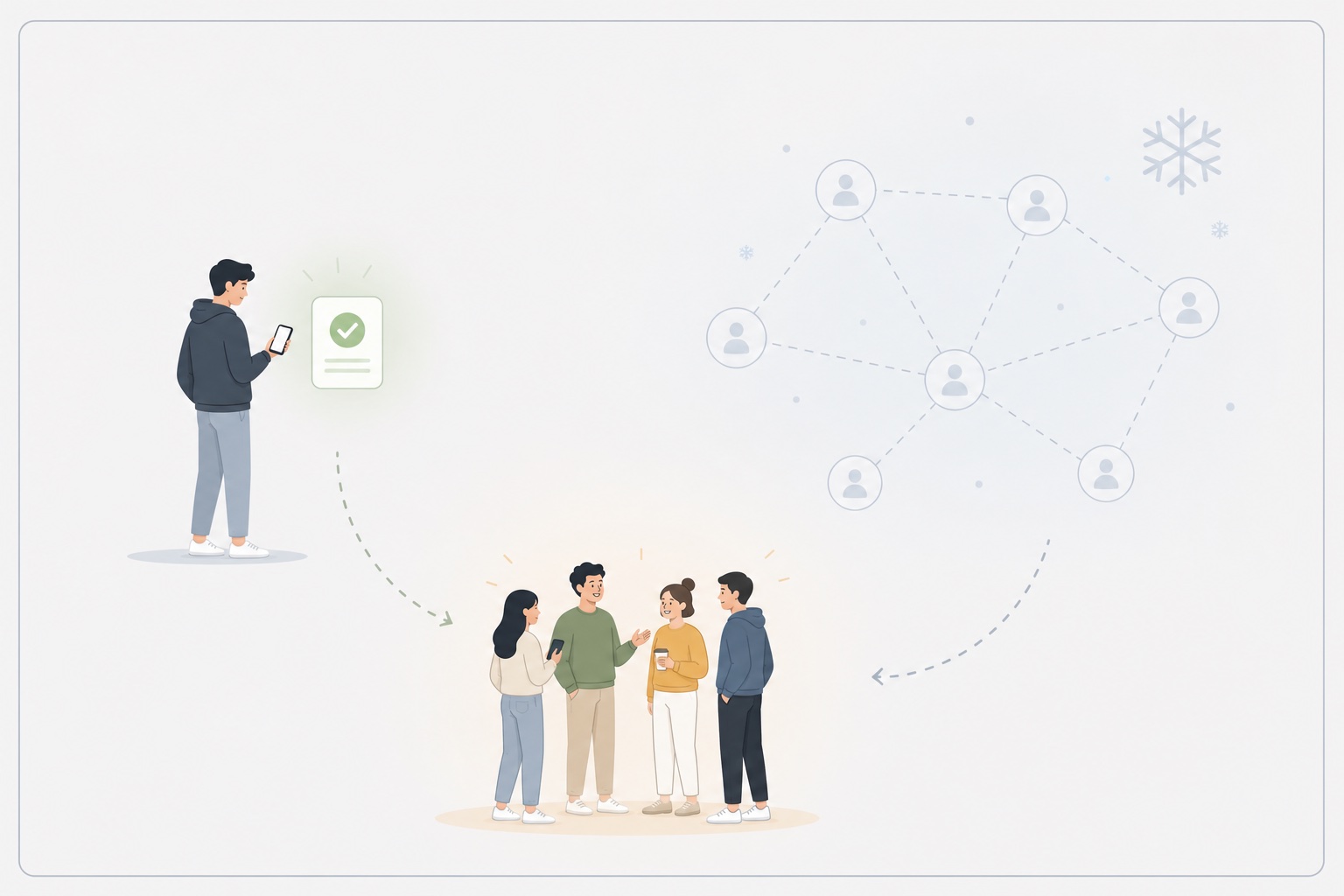
Illustration of the cold start problem. Created with GPT Image.
SWIQ: Why would anyone install the app?
With SWIQ I wanted to help people make decisions. Which haircut? Which outfit? Which logo? You create a question, others vote. Sounds simple. Technically, at some point, it was. But at the start I treated it like a proper social app. Sign up, profile, stay in the app, discover challenges. I was proud of the UI. It was fast, clear, modern. And still I got stuck on a banal question I asked too late: why should anyone sign up and go through a whole process just to vote on ten or thirty challenges? It makes no sense. Not for a user who just wants to give a quick opinion.
Walking up to someone and saying "Try out my app" was a process. It didn't feel cool. It felt like asking for a favour. And every time I did it, I could feel I wasn't selling the product. I was selling a hurdle. The answer wasn't another feature. The answer was to remove the hurdle. Anonymous voting. And above all: voting on the web, no install. You get a link, click, vote, done. That changed everything for me. Suddenly nobody needed my app to do me a favour. People used it because it worked for them in that moment. Not because a community already existed.
Ballin: Too complex to explain what it's for
Ballin was the opposite of minimal. I built a thoroughly complex app that I thought was cool myself. Lots of ideas, lots of corners, lots of "we could also do this". And at some point I sat there and couldn't explain to myself in one sentence what the app was actually for. Not in an embarrassing way. In a warning-sign way. If I, as the builder, can no longer put the core into clear words, how is a new user supposed to?
Then there was monetisation. What should cost what? Why would anyone pay? I had answers in my head, but none that felt natural. Ballin had a shareable object: the player card. In theory, the right idea: instant value, instantly shareable. In practice I was too busy making the app big instead of perfecting the one moment when someone says: "I want that card." Today, with every new idea, I first ask myself a simple question: what do I actually want to do? And how can the user do it so quickly and in such a cool way that they don't have to stop and think about whether to join in?
Fupla: 400 users who weren't active
Fupla was the closest to what Andrew Chen describes. Playing football, finding players, finding opponents, clubs, camps, pitches. Many sides, many connections, a lot of potential. I built too many features, without a clear focus and without a small local community as a starting point. I actually got to around 400 users at some point. That sounds good on paper. In reality they weren't active. The app was there, but too little happened. I allowed tournaments without promoting them properly and without having the right users for them. The same pattern again: I built something that's supposed to work once everyone else is already playing along. Not something that already makes sense for one person.
The focus on "I'm looking for a game of football" didn't come on day one. It came after I realised that breadth without depth gets you nowhere. One real need in one region. One concrete problem. Not a social network for everything and everyone, but an answer to a question someone has today.
The book came after the failure
I don't read this stuff to sound clever. I read Andrew Chen's The Cold Start Problem after I'd already hit the wall in several places. I read many passages with a queasy feeling, because I recognised myself in them. Network first. Wait for critical mass. Hope it tips at some point once enough people are there. The book gave me words for something I'd already felt. But the real lesson came from building, not from reading.
One question I ask myself today
I used to think: network first. Build the app, stack features, convince people to join, wait until it comes alive. Today I ask myself with every idea: what does user number one get without waiting for user number two? With SWIQ it was voting via a link. With Ballin it would have been the card, if I hadn't built so much around it. With Fupla it's finding a game, not the vision of a complete football ecosystem on day one.
You don't solve the cold start problem with a trick. It gets easier when you stay honest and shape the product so it already works for one person.
Who I'm writing this for
I'm not writing this as a success story, and not as a guide with the one right answer either. I'm writing it for people who are building something right now and notice that it isn't clicking. Maybe you already have users but not much movement. Maybe you explain your app three times and still only get polite nods. Maybe you have a UI you're proud of, and still nobody wonders why they should install it. That's exactly where I was.
If you're at that point, it can help to hear that you're not the only one going through this. Not because it gets easier then. But because you stop telling yourself the problem is just marketing or patience. Sometimes it's the product. The fact that the first user still walks away empty-handed.
Why I'm publishing this
It took me a long time to understand that good tech alone isn't enough. That it's not a character flaw if people don't get your app right away or don't want to join in right away. That it's normal to build features that only make sense once everyone is already there. I hope someone who's right in the middle of it finds a text that names this, without sugar-coating and without preaching.
The apps exist. Ballin, SWIQ and Fupla aren't buried. I'm building all of them, but this time each one around exactly one problem. Not the big network at the start, but the one moment when user number one already gets something. SWIQ and Fupla are already in the app stores. With Fupla, I'm still fine-tuning the focus. Ballin is still in the starting blocks. What I describe here is a look back at what went wrong. What comes next is the attempt to do it differently.
I'll report on how it goes. What I build, what I cut, what works and what gets stuck again. Not as advertising, but as an honest logbook. If you're building something yourself, maybe one step or another will help you. If not, at least I've written down for myself what I want to remember.