Since 2025 and 2026, you often see the same clip on lots of accounts across TikTok, Instagram Reels and YouTube Shorts. There's rarely just fan editing behind it. It's a market: someone pays for reach, someone edits or films, someone publishes on their own profile. In feeds and forums, almost all of this gets called "clipping". That's imprecise. If you want to understand the business model, you have to separate the models. Otherwise you end up measuring views when you wanted customers, or clipping someone else's material without having the rights.
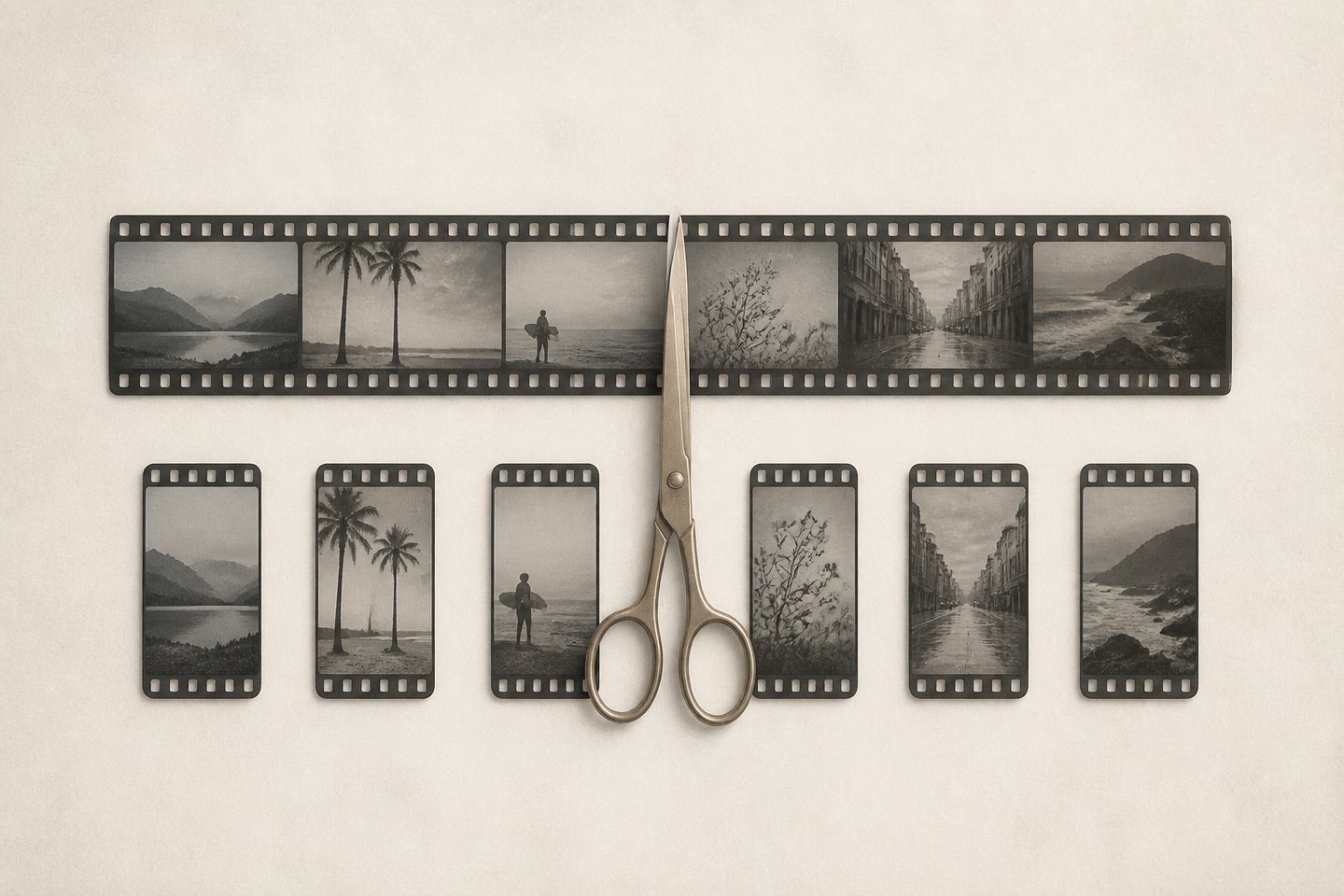
Illustration of cutting long-form into shorts. Created with GPT Image.
What is social media clipping?
Social media clipping means cutting existing long-form content into short videos for TikTok, Instagram Reels or YouTube Shorts, often for performance-based pay.
A social media clipper is the person who does this editing and usually posts the result on their own account. Typical sources are podcasts, livestreams, webinars or interviews. The clip isn't its own script. It's a selection: hook, cut, subtitles, often music.
That's social media clipping in the narrow sense. Alongside it, very different jobs are often sold under the same word: passing on finished assets, shooting a video yourself to a brief, or only getting paid when someone clicks or buys.
Why is the topic everywhere right now?
Short videos are the discovery channel. A livestream mainly reaches people who are already watching. The clip travels through recommendation feeds looking for new viewers. In May 2026, NPR described a "clip economy": marketplaces list campaigns, agencies and creators pay per view, and clippers upload the same edit to several platforms. At the same time, The Verge documented how podcasts, streamers and brands book exactly these campaigns, and that labelling as advertising is often missing.
Meanwhile, tools and marketplaces have emerged that standardise the job: brief, source file, submit link, payout. That lowers the barrier to entry. It explains the hype better than any single viral video.
Whether this becomes a lasting distribution channel is a different question from whether individual platforms and rates will stick around. The mechanism, short-form as a distributor for long-form or for a brand, is older than the term "clipper". The marketplace around it is young and changes fast. All platform details below refer to publicly available information as of September 2026.
Five models that get mixed up in the feed
| Clipping | Reposting | UGC | Content rewards | Affiliate content | |
|---|---|---|---|---|---|
| Who creates the content? | Clipper edits supplied material | Usually nobody new; the file gets passed on | Creator shoots their own video | Depends on the campaign type (clip or original) | Creator or clipper, plus link/code |
| Existing content? | Yes, long-form | Yes, finished assets or approved clips | No, except permitted product shots | Optional | Optional |
| Who publishes? | Usually the clipper, on their own account | Many accounts, often to a spec | The creator | The participating account | The participating account |
| Typical pay | Piece rate per 1,000 views after approval | Flat fee, view rate or unpaid | Higher view rate, flat fee or a mix | Tied to views, posts or other metrics | Commission per click, lead or purchase |
| Primary goal | Reach for the source material | Broad distribution | Trust, proof, message | Scalable performance against a budget | Measurement all the way to conversion |
| Measurability | Platform views of the clips | Views/reposts | Views plus qualitative review | Views according to the platform's rules | Funnel: view → click → action |
Classic clipping takes existing material and turns it into shorts. Without usage rights, that's not marketing, it's a copyright risk.
Reposting distributes clips or assets that are already finished. The effort lies in accounts and timing, not in editing.
UGC (user-generated content) here means original content made to a brief. The campaign can require participants to film themselves. That's not clipping, even if the same platform offers both.
Content rewards is the payment logic: money follows defined results, often views, sometimes an approved post plus minimum views. The name is ambiguous. At Whop, "Content Rewards" is the name of an app for exactly these kinds of campaigns. contentrewards.com (opens in a new tab) is a separate product with its own budgets and fees. Don't lump the two together.
Affiliate or performance content is more closely tied to the funnel. Views are a means, not the goal.
Clipping marketing for businesses can use any of these variants. Only the maths changes.
Who pays whom, and how clippers make money
The chain is short. The paying side is the rights holder or the brand: streamer, podcast, app, agency. They put up a budget and a rate. The platform brokers, reviews submissions and takes a fee. The clipper or creator publishes on TikTok, Instagram or YouTube Shorts and submits the URL. After approval, money flows as long as the budget and caps last.
That's piece rate, not a salary. Many clips earn little or nothing because they don't reach the threshold, get rejected, or the budget runs out first. Whether you need lots of followers is decided by each campaign, not by the term "clipper". In 2026, The Verge mentioned a Perplexity campaign on Vyro that required more than 10,000 followers. Other briefs are more open. So a blanket "start without any reach" isn't a reliable claim.
Two marketplaces that came up often in 2026 coverage:
In its documentation, Whop describes two campaign types: clipping from long-form, and UGC following guidelines. According to the docs, TikTok, YouTube Shorts, X and Instagram Reels are allowed. Brands set a budget, a rate per 1,000 views, an optional minimum and maximum payout, plus an optional flat fee. According to Whop's FAQ there's no minimum budget, but the budget has to be paid in before the campaign goes live. Whop's Content Rewards terms of service state a 10 percent fee on the amounts sellers pay to participants. Submissions can be reviewed automatically; if a matching submission sits unprocessed for 48 hours, it can be approved automatically, according to Whop's blog. How views are filtered against bots internally is only described roughly in public (approval, botting flag). That's not an independent audit method.
Vyro describes itself as a clipping platform for campaigns by creators and brands. Clippers connect their accounts, follow the brief, post, and submit the link. The rate is set in the campaign as a CPM (cost per 1,000 views). Views can count from submission; you earn after approval and once the threshold is met, until the budget runs out. According to the website, the end of a campaign is followed by a view review, then payout. From US$10, once a week, via Stripe or PayPal depending on the country. The official site doesn't name a fixed platform CPM as a standard.
For brands this means: you're not buying a guarantee of customers. You're buying, if the campaign is built that way, reviewed or at least reported views plus reach on other people's accounts. For clippers, "making money as a clipper" means volume, editing quality, sticking to the brief, and luck in the feed. There's no credible average forecast.
How creators, businesses and brands use it
A business doesn't always need an edit. It needs a goal.
If it wants to recycle existing long-form, classic clipping makes sense: one long video, clear rights, caps so that one viral hit doesn't eat the whole budget.
If it only wants distribution, assets and reposting are enough.
If it wants credible voices, UGC is the right lever. Yes: campaigns can require participants to create their own videos. Whop treats this internally as a separate type and says UGC typically pays higher rates than clipping.
If it wants to see the funnel, it needs tracking links or affiliate codes. Then performance content is closer to performance marketing than to an editing contest.
The same goes for creators who have others clip for them: the clip is distribution, not automatically a new product. If you only optimise for views, you can get the same effect as with classic reach advertising, including wasted reach. The problem is similar to the one I described in my post on the cold start problem: reach without one clear next step stays empty.
Hypothetical example: a new social app
An app wants reach. Four clean variants, no real brand.
Variant A: clipping. The app provides a 20-minute explainer video. Clippers cut 20–40 seconds, add subtitles, and post on TikTok and Reels. The app pays a rate per 1,000 views. It scales editing work, not filming.
Variant B: reposting. The app supplies finished 9:16 assets. Accounts spread them. Little creative deviation, a lot of control over image and text.
Variant C: UGC. There's only a brief: a question that makes the product visible, plus dos and don'ts. Creators film themselves, and the app shows up organically. This is where new content gets created. That's UGC vs clipping in its purest form.
Variant D: tracking. Every creator gets their own link. The app sees the funnel: video → view → click → visit → sign-up.
That's why 500,000 views aren't automatically worth more than 50,000. If the big clips run in a country where the app isn't launching, or viewers consume the clip as entertainment and never tap, the app is buying attention. The smaller clips with a link and the right audience can bring in more sign-ups. Views are an upstream metric. Conversion is the downstream metric. If you only buy CPM, you should know that before the budget runs out.
Whether you "just" stick with views or measure the funnel is a product decision. Building simple here means picking one metric that fits the user's next step, not chasing every number at once.
Opportunities, risks: hype or channel?
The opportunity for rights holders: short-form reach without editing every clip yourself. The opportunity for clippers: a clear job and a rate. The opportunity for brands: many variants of the same message, fast.
The risks are concrete. Copyright: without a licence, the edit is open to challenge. Brand safety: the same clip sits next to accounts the brand would never have chosen. Fake views and engagement manipulation: NPR and marketplace interfaces openly address botting; platform numbers aren't accounting. Labelling: The Verge noted that many clip campaigns carry no sponsorship disclosure. In the EU and in Austria, that's an issue in its own right, not an optional hashtag.
My take, separate from the facts: distribution via shorts is here to stay. The hype around individual marketplaces, rates and "anyone can be a clipper" will wear off once budgets get measured more precisely and platforms crack down harder on mass reposts. As a distribution channel, clipping is relevant in 2026. As a promise that you can reliably make a living from it, it isn't.
The legal side, briefly and without advice
This isn't legal advice.
Copyright and usage rights. If you clip, you need the rights to the source material, and often to the music and the people shown. The brand's brief only replaces that if it actually grants those rights.
Label advertising. As soon as money or any other consideration changes hands, in Austria the clip generally counts as commercial communication. Guidance comes from the UWG, MedienG and AMD-G (Austria's laws on unfair competition, media, and audiovisual media services) and from the IAA Austria industry guide "THE PAPER" (2026). Common labels are "Werbung" or "Anzeige" (German for "advertisement"), visible and early. Platform toggles don't replace the legal obligation.
Platform rules. Mass identical uploads, misleading edits and bought interactions can break the rules of TikTok, Instagram or YouTube, regardless of the marketplace.
Fake views. Buying views or using bots defrauds the paying side and risks a ban plus clawback. Brands that only buy the dashboard counter carry the opposite risk.
Brand safety. Open marketplaces scale reach and loss of control at the same time.
Conclusion
In 2026, at least five things go by the name "clipping": editing long-form, redistribution, self-shot UGC, view-based rewards and conversion-focused affiliate models. Social media clippers earn when a campaign pays them and the feed plays along, not because the term guarantees a business model. Businesses should pick the goal first, then the model, then the metric. If you only buy views, you get views. If you want sign-ups, you have to measure the click too.
FAQ
What is a social media clipper?
A social media clipper cuts existing long-form videos into short clips and usually publishes them on their own account. Some earn money from it through pay-per-view campaigns. The title alone says nothing about income or follower count.
What does clipping mean on TikTok?
In practice, clipping on TikTok means a short cut from a longer video, often with subtitles and music, in the For You feed. Paid campaigns can also require hashtags, mentions or labelling.
What is clipping on Instagram and YouTube Shorts?
The same mechanism, in Reels or Shorts. Many campaigns allow several networks; then each platform is often counted separately, if the brief says so.
Can you make money with clipping?
Yes, in individual campaigns, as piece rate. There's no reliable floor and no guarantee. Most clips stay below the thresholds or share a limited budget.
How are clippers paid?
Typically a rate per 1,000 views after approval, sometimes plus a flat fee, rarely only per approved post. Affiliate campaigns pay per click, lead or sale. Payout runs through the marketplace (for example as credit, via Stripe or PayPal), not through the social app.
Do you need lots of followers for clipping?
Not always. Some campaigns are open, others set follower or view minimums. That's in the brief, not in the definition.
What are content rewards?
Content rewards tie pay to defined results, often views. At Whop it's the name of a campaign app (clipping and UGC). Elsewhere, the same name refers to a separate product. Always read up on the specific platform.
Is clipping the same as UGC?
No. Clipping repurposes existing material. UGC is newly created to a brief. Both can be paid based on views. That's why they look similar in the feed but differ contractually.
Can businesses use clippers for marketing?
Yes, as clipping marketing: clear the rights, write a brief, set caps, require labelling, and ideally measure the funnel. It replaces neither classic ads nor your own content pipeline.
Does a clipper have to use existing videos?
For classic clipping, yes. For UGC or brief-based campaigns, no. The job decides.
Can creators get paid for videos they produce themselves?
Yes. That's UGC or performance content, not clipping. Whop lists UGC as a separate type and says it typically pays higher rates.
What are the risks of social media clipping?
Rights, missing labelling, fake views, brand safety problems, and wasted reach when only views count.
Does clipping violate copyright?
Without usage rights, the edit can be unlawful. With an explicit licence from the rights holders, it's the whole point of the campaign. Music and faces are separate questions.
Is clipping still relevant in 2026?
As a distribution route for short-form, yes. As a single hyped marketplace, not necessarily for good. The ones who stay relevant are those who have rights, brief and metric under control.
Sources
- NPR, 12 May 2026: How short form video "clippers" are overrunning the internet (opens in a new tab)
- The Verge: Inside the cutthroat community of ‘clippers’ (opens in a new tab)
- Whop Docs: Content Rewards (opens in a new tab)
- Whop: How to set up Whop Content Rewards (opens in a new tab)
- Whop: Content Rewards Terms of Service (opens in a new tab)
- Vyro: Homepage (opens in a new tab)
- Vyro Help: What is Vyro? (opens in a new tab)
- IAA Austria: THE PAPER — Influencer Marketing Guide (opens in a new tab) (in German)
- Influencer Marketing Guide AT: Content & Recht (opens in a new tab) (in German)