People sometimes ask me why I'm working on SWIQ. The honest answer: the idea didn't start with me alone. It started with a conviction that Ilker Dogru (LinkedIn profile) and I have shared for a long time. We both believe our future lies in working for ourselves, not as a romantic picture of freedom, but as a real decision to build something of our own and take responsibility for it. That mindset connected us from the start. Before SWIQ existed, we were already talking about what we wanted to build, what we were willing to invest our time in, and what we'd stick with even when things got hard.
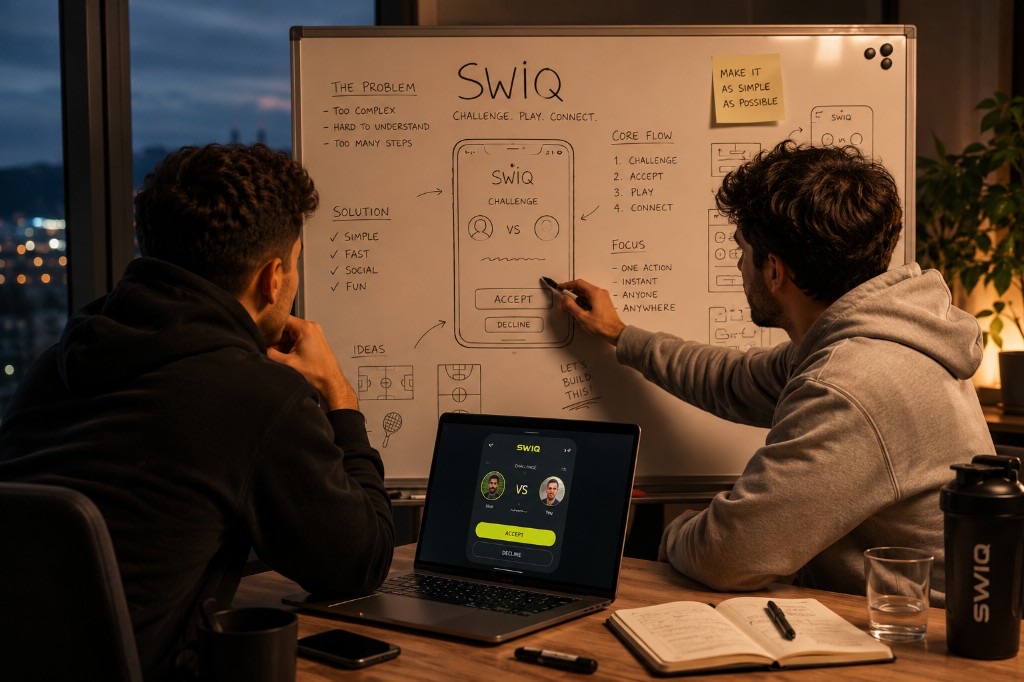
Illustration of an early SWIQ brainstorming session. Created with GPT-5.5 Thinking.
The first attempt
So we teamed up. Our first idea was an app around football, basketball, and padel. We wanted to bring playing sports into the digital world and connect people in a way that feels natural when you're someone who loves to move. I still remember how quickly we had a proof of concept back then. That was motivating. You see something on screen, you can touch it, you feel: this could work. I thought the idea itself was great. Ilker did too. We were convinced there was something there.
And yet we noticed the app wasn't immediately clear to everyone. People needed time to understand what they were supposed to do. Sometimes we had to explain. Sometimes they stopped after a few minutes. That wasn't a technical problem. It was a feeling. Ilker and I often sat together in those moments and asked: what's actually missing here? The answer, for us, was surprisingly simple. We need something that's instantly understandable. No intro, no tutorial, no sense of "I have to learn this first." Everyone should know what to do the moment the app opens.
The sentence on the phone
One evening, Ilker said something on the phone that stuck with me. He wants to go outside, hit the street, and challenge someone, ideally with as few taps as possible. No detours, no long setup, no feeling that you have to understand an app before you're allowed to start. I listened and nodded internally because I knew he was right. At the same time, I was stuck on what something like that should look like. I could imagine the flow, but not the interface. A split screen, for example, felt too heavy to me. Too technical. Too unlike something you'd do spontaneously when you run into someone on the street.
I spent a long time thinking about how to convey that simplicity visually, not as a feature list, but as a feeling. That you open the app and immediately know: this is where it starts. That you can challenge someone without wondering whether you're hitting the right button. Ilker had articulated the need clearly. I still had to find the form for it.
The prototype and the surprise
AI models exist today, and that changed how fast you can test ideas. A UX experiment like this would have taken weeks before. For me, it became a matter of days and carefully written prompts. I started building a prototype. Ilker didn't know about it at first. That was intentional. I wanted to show him something that already felt real, not something that still needed explaining.
When the moment came, I was nervous. Ilker isn't someone who politely nods when he doesn't like something. He's a tough critic, but in a way I appreciate. He says what he thinks, diplomatically but clearly. That's exactly why his feedback matters so much to me. I was curious, but also a little tense. For the first time, I was fully convinced of the UX myself. I hadn't felt that strongly about our ideas before. I knew how it should feel. Now I could show it.
Ilker was excited. Not the polite "yeah, could be something." Real excitement. In that moment, I knew the path was clear to start building properly. Not just talking, not just sketching, but building.
What matters today
SWIQ is still in its early days. That's no secret. Still, it's clear to me what we're going for. We're building something simple. Something you understand immediately. Challenge someone, respond, move on. No preamble. Exactly what Ilker meant on the phone that evening, only this time in a form that actually feels right.
I'm not writing this because we've already arrived. I'm writing it because the path there is, for me personally, one of the most exciting I know. From a big idea that was too complex to something small that's instantly clear. From conversations to a prototype you can put in someone's hands. From the conviction that working for ourselves is our future to a product we're building step by step. SWIQ has become what Ilker and I were looking for from the start: something real you can feel the moment you hold it.